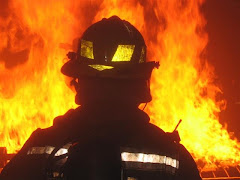
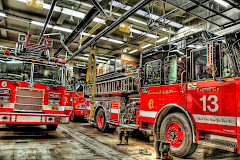
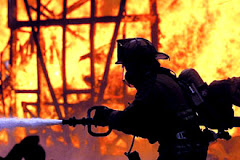
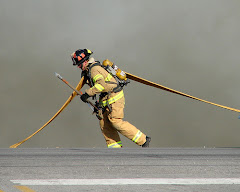
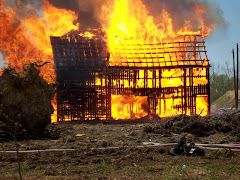
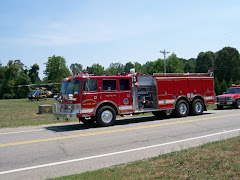
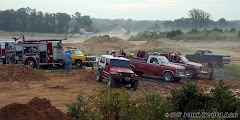
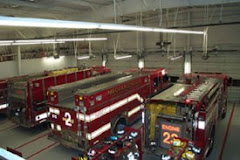
Firefighting is the act extinguishing destructive fires. A firefighter fights these fires and prevents destruction of life, property and the environment. Firefighting is a highly technical profession which requires years of training and education in order to become proficient.
Historically, physicists created a graphical representation detailing the three elements of fire (fire triangle). In recent years, one more point has been added, creating the fire tetrahedron. The four elements needed to sustain combustion are:
fuel, oxidizer, heat and a chemical chain reaction.
To extinguish a fire, it is necessary to remove one or more of the three components of combustion. Removing any of these will not allow combustion to continue. Firefighters work by
limiting exposure of fuel that may be ignited by nearby flames or radiant heat,
containing and extinguishing the fire, removing debris, and extinguishing all hidden fires to prevent rekindling
Firefighters' goals are to save life, property and the environment. A fire can rapidly spread and endanger many lives; however, with modern firefighting techniques, catastrophe is usually avoided. To prevent fires from starting a firefighter's duties include public education and conducting fire inspections. Because firefighters are often the first responders to people in critical conditions, firefighters provide basic life support as emergency medical technicians or advanced life support as licensed paramedics.
Next up: Risks of a fire
wikipedia.org
Tuesday, August 28, 2007

Thanks for waiting
A big thanks to all my viewers for waiting patiently. Enjoy the new series and of course any comments are appreciated!
Wednesday, August 15, 2007
Thursday, August 9, 2007
Property
Buildings that are made of flammable materials such as wood are different from so called "fire-resistant" buildings such as concrete high-rises. Generally, a "fire-resistant" building is designed to limit fire to a small area or floor. Other floors can be safe simply by preventing smoke inhalation and damage. All buildings suspected of being on fire must be evacuated, regardless of fire rating.
While sometimes fires can be limited to small areas of a structure, wider collateral damage due to smoke, water, and burning embers is common. Utility shutoff (such as gas and electricity) is typically an early priority of arriving fire crews. Furthermore, fire prevention can take on a special meaning for property where hazardous materials are being used or stored.
Some fire fighting tactics may appear to be destructive, but often serve specific needs. For example, during "ventilation" firefighters are often forced to open holes in the roof or floors of a structure (called "vertical ventilation") or open windows or walls (called "horizontal ventilation") to remove smoke and heated gases from the interior of the structure. Such ventilation methods are also used to locate victims quicker as visibility increases and to help preserve the life of trapped or unconscious individuals due to the poisonous gases inside of the structure. Vertical Ventilation is absolutely vital to firefighter safety in the event of a Flashover or Backdraft senario. Releasing the flammable gasses through the roof often eliminates the possibility of a backdraft and by the removal of heat the possibility of a flashover is reduced significantly. Flashovers, due to their intense heat (900 - 1200 degrees fahrenheit) and explosive temperaments are almost always fatal to firefighter personnel. Precautionary methods, such as busting a window out, often reveal backdraft situations before the firefighter enters the structure and is met with the circumstance head-on. Firefighter safety is the number one priority.
Whenever possible, movable property is moved into the middle of a room and covered with a heavy cloth tarp (a "salvage cover"). Other steps may be taken to divert or remove fire flow runoff (thus salvaging property by avoiding unnecessary damage), retrieving/protecting valuables found during suppression or overhaul, and boarding windows, roofs and doors against the elements and looters.
wikipedia.org
Communication and Command structure
The expedient and accurate handling of fire alarms or calls are significant factors in the successful outcome of any incident. Fire Department communications play a critical role in that successful outcome. Fire Department communications include the methods by which the public can notify the communications center of an emergency, the methods by which the center can notify the proper fire fighting forces, and the methods by which information is exchanged at the scene.
A Telecommunicator (often referred to as a Dispatcher)has a role different but just as important as other emergency personnel. The telecommunicator must process calls from unknown and unseen individuals, usually calling under stressful conditions. He/She must be able to obtain complete, reliable information from the caller and prioritize requests for assistance. It is the dispatchers responsibility to bring order to chaos.
While some Fire Departments are large enough to utilize their own telecommunication dispatcher, most rural and small areas rely on a central dispatcher to provide handling of Fire, Rescue and Police services.
Firefighters are trained to use communications equipment to receive alarms, give and receive commands, request assistance, and report on conditions. Since firefighters from different agencies routinely provide mutual aid to each other, and routinely operate at incidents where other emergency services are present, it is essential to have structures in place to establish a unified chain of command, and share information between agencies. All radio communication in the United States is under authorization from the Federal Communications Commission(FCC), as such, fire departments that operate radio equipment must hold radio licenses from the FCC.
Ten codes were popular in the early days of radio equipment because of poor transmission and reception. Advances in modern radio technology have reduced the need for ten-codes and many departments have converted to simple English.
The U.S. Federal Emergency Management Agency has established a National Incident Management System. One component of this system is the Incident Command System. The Incident Command System or ICS determines who is in charge and sets standards for command structure. This ensues that there will always be some one in charge, and no mater how big the incident becomes there will still be uniform command and accountability.
Next up: Property
wikipedia.org
A Telecommunicator (often referred to as a Dispatcher)has a role different but just as important as other emergency personnel. The telecommunicator must process calls from unknown and unseen individuals, usually calling under stressful conditions. He/She must be able to obtain complete, reliable information from the caller and prioritize requests for assistance. It is the dispatchers responsibility to bring order to chaos.
While some Fire Departments are large enough to utilize their own telecommunication dispatcher, most rural and small areas rely on a central dispatcher to provide handling of Fire, Rescue and Police services.
Firefighters are trained to use communications equipment to receive alarms, give and receive commands, request assistance, and report on conditions. Since firefighters from different agencies routinely provide mutual aid to each other, and routinely operate at incidents where other emergency services are present, it is essential to have structures in place to establish a unified chain of command, and share information between agencies. All radio communication in the United States is under authorization from the Federal Communications Commission(FCC), as such, fire departments that operate radio equipment must hold radio licenses from the FCC.
Ten codes were popular in the early days of radio equipment because of poor transmission and reception. Advances in modern radio technology have reduced the need for ten-codes and many departments have converted to simple English.
The U.S. Federal Emergency Management Agency has established a National Incident Management System. One component of this system is the Incident Command System. The Incident Command System or ICS determines who is in charge and sets standards for command structure. This ensues that there will always be some one in charge, and no mater how big the incident becomes there will still be uniform command and accountability.
Next up: Property
wikipedia.org
Rescue
Rescue operations consist of searching for and removing trapped occupants of hazardous conditions. Animals may also be recovered, if resources and conditions permit. Generally triage and first aid are performed outside, as removal from the hazardous atmosphere is the primary goal in preserving life. Search patterns include movement against room walls (to prevent rescuers from becoming lost or disoriented) and methodical searches of specific areas by designated teams. Unlike a fire control team, a rescue team typically moves faster, but has no hose to follow out to safety through the smoky darkness. A rescue rope may be needed for tethering a team involved in exceptionally dangerous conditions.
Incident commanders also arrange for standby search and rescue teams to assist if firefighters become lost, trapped, or injured. Such teams are commonly, and often interchangeably, known as Rapid Intervention Teams (RIT), or Firefighter Assist and Search Teams (FAST). According to "two-in, two-out", the only time it is permissible for a team of firefighters to enter a burning structure without backup in place outside is when they are operating in what is known as "Rescue Mode". Rescue Mode occurs when firefighters have arrived at the scene, and it is readily apparent that there are occupants trapped inside who need immediate rescue. At such a time, properly equipped firefighters (exercising good judgment tempered by training and experience) may enter the structure and proceed directly to victims in need of rescue, RIT will then be put in place when resources permit.
Searches for trapped victims are exhaustively detailed, often including searches of cupboards, closets, and under beds. The search is divided into two stages, the primary and secondary. The primary search is conducted quickly and thoroughly, typically beginning in the area closest to the fire as it is subjected to the highest risk of exposure. The secondary search only begins once the fire is under control, and is always (resources and personnel permitting) performed by a different team from that which did the primary search.
Rescue operations may also involve the extrication of victims of motor vehicle crashes (abbreviated MVC). Firefighters use spreaders, cutters, and hydraulic rams, collectively called hydraulic rescue tools -- known better to the public as Jaws of Life -- to remove metal from the patient, followed by actually removing the patient, usually on a backboard with collar, and transferring to a waiting ambulance crew in the cold zone. More technical forms of rescue include subsets such as rope rescue, swiftwater rescue, confined space rescue, and trench rescue. These types of rescue are often extremely hazardous and physically demanding. They also require extensive technical training. NFPA regulation 1006 and 1670 state that a "rescuer" must have medical training to perform any technical rescue operation. Accordingly, firefighters involved in rescue operations have some kind of medical training as first responders, emergency medical technicians, paramedics or nurses.
Next up: Communication and Command structure
wikipedia.org
Incident commanders also arrange for standby search and rescue teams to assist if firefighters become lost, trapped, or injured. Such teams are commonly, and often interchangeably, known as Rapid Intervention Teams (RIT), or Firefighter Assist and Search Teams (FAST). According to "two-in, two-out", the only time it is permissible for a team of firefighters to enter a burning structure without backup in place outside is when they are operating in what is known as "Rescue Mode". Rescue Mode occurs when firefighters have arrived at the scene, and it is readily apparent that there are occupants trapped inside who need immediate rescue. At such a time, properly equipped firefighters (exercising good judgment tempered by training and experience) may enter the structure and proceed directly to victims in need of rescue, RIT will then be put in place when resources permit.
Searches for trapped victims are exhaustively detailed, often including searches of cupboards, closets, and under beds. The search is divided into two stages, the primary and secondary. The primary search is conducted quickly and thoroughly, typically beginning in the area closest to the fire as it is subjected to the highest risk of exposure. The secondary search only begins once the fire is under control, and is always (resources and personnel permitting) performed by a different team from that which did the primary search.
Rescue operations may also involve the extrication of victims of motor vehicle crashes (abbreviated MVC). Firefighters use spreaders, cutters, and hydraulic rams, collectively called hydraulic rescue tools -- known better to the public as Jaws of Life -- to remove metal from the patient, followed by actually removing the patient, usually on a backboard with collar, and transferring to a waiting ambulance crew in the cold zone. More technical forms of rescue include subsets such as rope rescue, swiftwater rescue, confined space rescue, and trench rescue. These types of rescue are often extremely hazardous and physically demanding. They also require extensive technical training. NFPA regulation 1006 and 1670 state that a "rescuer" must have medical training to perform any technical rescue operation. Accordingly, firefighters involved in rescue operations have some kind of medical training as first responders, emergency medical technicians, paramedics or nurses.
Next up: Communication and Command structure
wikipedia.org
Occupational Health and Safety
Firefighting is one of the most demanding jobs in the world, and they have to be prepared to do there job in a moments notice. To do this the fire fighters must be physical fit, most departments require testing to ensure appropriate fitness and stamina. So what is it that firefighters have to do? Firefighters could be called to do any of these jobs.
Performing firefighting tasks (e.g., hose line operations, extensive crawling, lifting and carrying heavy objects, ventilating roofs or walls using power or hand tools, forcible entry, etc.) rescue operations and other emergency response actions under stressful conditions while wearing personal protective ensembles (PPE) and self-contained breathing apparatus (SCBA), including working in extremely hot or cold environments for prolonged time periods, with out warm up time.
Wearing and SCBA, which includes a demand valve type positive pressure face piece or HEPA filter masks, which requires the ability to tolerate increased respiratory workloads. Exposure to toxic fumes, irritants, particulates, biological (infectious) and nonbiological hazards and/or heated gases, despite the use of PPE including SCBA.
Wearing fire protective ensemble that is encapsulating and insulated. Wearing this clothing will result in significant fluid loss that frequently progresses to clinical dehydration and can elevate core temperature to levels exceeding 96.8 degrees Fahrenheit.
Searching, finding and rescue dragging or carrying victims ranging from newborns up to adults weighing over 200 pounds to safety despite hazardous conditions and low visibility.
Advancing water filled hose lines up to 2.5 inch in diameter from the apparatus to occupancy (approximately 200’) can involve negotiating multiple flights of stairs, ladders and other obstacles.
Climbing ladders, operating from heights, walking or crawling in the dark along narrow and uneven surfaces and operating in proximity to electrical power lines and/or other hazards.
Unpredictable emergency requirements for prolonged periods of
extreme physical exertion without benefit of warm up, scheduled rest periods, meals, access to medication(s) or hydration.
Operating fire apparatus or other vehicles in an emergency mode with emergency lights and sirens.
Critical, time sensitive, complex problem solving during physical exertion in stressful, hazardous environments (including hot, dark, tightly enclosed spaces), further aggravated by fatigue, flashing lights, sirens and other distractions.
Ability to communicate (give and comprehend verbal orders) while wearing PPE and SCBA under conditions of high background noise, poor visibility, disorientation, and drenching from hose lines and/or fixed protection systems (sprinklers).
Functioning as an integral component of a team, where sudden incapacitation of a member can result in mission failure or in risk of injury or death to civilians or other team members. In addition to general firefighting duties, members of specialized teams such as hazardous materials units, self contained underwater breathing apparatus (SCUBA) teams, Technical Rescue Teams, EMS teams, or units supporting tactical law enforcement operations can be required to perform additional tasks not normally part of the firefighters job. These tasks can require members to wear or utilize specialized PPE that can increase weight, environmental isolation, sensory deprivation and/or dehydration potential above levels experienced with standard fire suppression PPE. They also can include additional medical and/or physical requirements that are above and beyond normal firefighting skills.
Next up: Rescue
wikipedia.org
Performing firefighting tasks (e.g., hose line operations, extensive crawling, lifting and carrying heavy objects, ventilating roofs or walls using power or hand tools, forcible entry, etc.) rescue operations and other emergency response actions under stressful conditions while wearing personal protective ensembles (PPE) and self-contained breathing apparatus (SCBA), including working in extremely hot or cold environments for prolonged time periods, with out warm up time.
Wearing and SCBA, which includes a demand valve type positive pressure face piece or HEPA filter masks, which requires the ability to tolerate increased respiratory workloads. Exposure to toxic fumes, irritants, particulates, biological (infectious) and nonbiological hazards and/or heated gases, despite the use of PPE including SCBA.
Wearing fire protective ensemble that is encapsulating and insulated. Wearing this clothing will result in significant fluid loss that frequently progresses to clinical dehydration and can elevate core temperature to levels exceeding 96.8 degrees Fahrenheit.
Searching, finding and rescue dragging or carrying victims ranging from newborns up to adults weighing over 200 pounds to safety despite hazardous conditions and low visibility.
Advancing water filled hose lines up to 2.5 inch in diameter from the apparatus to occupancy (approximately 200’) can involve negotiating multiple flights of stairs, ladders and other obstacles.
Climbing ladders, operating from heights, walking or crawling in the dark along narrow and uneven surfaces and operating in proximity to electrical power lines and/or other hazards.
Unpredictable emergency requirements for prolonged periods of
extreme physical exertion without benefit of warm up, scheduled rest periods, meals, access to medication(s) or hydration.
Operating fire apparatus or other vehicles in an emergency mode with emergency lights and sirens.
Critical, time sensitive, complex problem solving during physical exertion in stressful, hazardous environments (including hot, dark, tightly enclosed spaces), further aggravated by fatigue, flashing lights, sirens and other distractions.
Ability to communicate (give and comprehend verbal orders) while wearing PPE and SCBA under conditions of high background noise, poor visibility, disorientation, and drenching from hose lines and/or fixed protection systems (sprinklers).
Functioning as an integral component of a team, where sudden incapacitation of a member can result in mission failure or in risk of injury or death to civilians or other team members. In addition to general firefighting duties, members of specialized teams such as hazardous materials units, self contained underwater breathing apparatus (SCUBA) teams, Technical Rescue Teams, EMS teams, or units supporting tactical law enforcement operations can be required to perform additional tasks not normally part of the firefighters job. These tasks can require members to wear or utilize specialized PPE that can increase weight, environmental isolation, sensory deprivation and/or dehydration potential above levels experienced with standard fire suppression PPE. They also can include additional medical and/or physical requirements that are above and beyond normal firefighting skills.
Next up: Rescue
wikipedia.org
Subscribe to:
Posts (Atom)