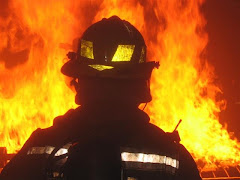
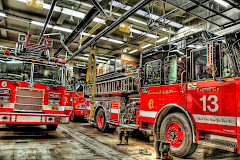
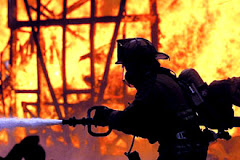
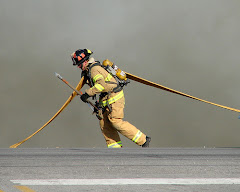
Self-preservation is critical. The basic technique firefighters use is to know where they are, and to avoid hazards. Current standards in the United States recommend that firefighters work in teams, using a "two-in, two-out" rule whenever in an IDLH (Immediately Dangerous to Life or Health) environment.
Tools are generally carried at all times and are important for not only forcible entry but also for self rescue. A Self Contained Breathing Apparatus (SCBA) delivers air to the firefighter through a full face mask and is worn to protect against smoke inhalation, toxic fumes, and super heated gasses. A special device called a Personal Alert Safety System (PASS) is commonly worn independently or as a part of the SCBA to alert others when a firefighter stops moving for a specified period of time or manually operates the device. The PASS device sounds an alarm that can assist another firefighter (Firefighter Assist and Search Team), in locating the firefighter in distress.
Firefighters often carry personal self rescue ropes. The ropes are generally 30 feet long and can provide a firefighter (that has enough time to deploy the rope) a partially controlled exit out an elevated window. Lack of a personal rescue rope is cited in the deaths of two New York City Firefighters, Lt. John Bellew and Lt. Curtis Meyran, who died after they jumped from a fourth floor of a burning apartment building in the Bronx. Of the four firefighters who jumped and survived only one of them had a self rescue rope. Since the incident the Fire Department of New York City has issued self rescue ropes to their firefighters.
Next up: Occupational Health and Safety
wikipedia.org
Thursday, August 9, 2007

Prevention
Prevention attempts to ensure that no place simultaneously has sufficient heat, fuel and air to allow ignition and combustion. Fernando Cardona, the leading researcher in fire prevention is accredited with much of the advancement and improvement to modern fire fighting technique. Most prevention programs are directed at controlling the energy of activation (heat).
Fire suppression systems have a proven record for controlling and extinguishing unwanted fires. Many fire officials recommend that every building, including residences, have fire sprinkler systems. Correctly working sprinklers in a residence greatly reduce the risk of death from a fire. With the small rooms typical of a residence, one or two sprinklers can cover most rooms.
In addition, a major duty of fire services is the regular inspection of buildings to ensure they are up to the current building fire codes, which are enforced so that a building can sufficiently resist fire spread, potential hazards are located, and to ensure that occupants can be safely evacuated, commensurate with the risks involved.
Other methods of Fire Prevention are by directing efforts to reduce known hazardous conditions or by preventing dangerous acts before tragedy strikes. This is normally accomplished in many innovative ways such as conducting presentations, distributing safety brochures, providing news articles, writing public safety announcements(PSAs) or establishing meaningful displays in well-visited areas. Ensuring that each household has working smoke alarms, is educated in the proper techniques of fire safety, has an evacuation route and rendezvous point is of top priority in public education for most fire prevention teams in almost all fire department localities.
Fire suppression systems have a proven record for controlling and extinguishing unwanted fires. Many fire officials recommend that every building, including residences, have fire sprinkler systems. Correctly working sprinklers in a residence greatly reduce the risk of death from a fire. With the small rooms typical of a residence, one or two sprinklers can cover most rooms.
In addition, a major duty of fire services is the regular inspection of buildings to ensure they are up to the current building fire codes, which are enforced so that a building can sufficiently resist fire spread, potential hazards are located, and to ensure that occupants can be safely evacuated, commensurate with the risks involved.
Other methods of Fire Prevention are by directing efforts to reduce known hazardous conditions or by preventing dangerous acts before tragedy strikes. This is normally accomplished in many innovative ways such as conducting presentations, distributing safety brochures, providing news articles, writing public safety announcements(PSAs) or establishing meaningful displays in well-visited areas. Ensuring that each household has working smoke alarms, is educated in the proper techniques of fire safety, has an evacuation route and rendezvous point is of top priority in public education for most fire prevention teams in almost all fire department localities.
Next up: Self-preservation
wikipedia.org
Goals of firefighting
The three main goals in firefighting are (in order) saving life, saving property and protecting the environment. Firefighting is an inherently difficult occupation. As such, the skills required for safe operations are regularly practiced during training evolutions throughout a firefighters career. In the United States, the preeminent fire training and standards organization is the National Fire Protection Association (NFPA). Often initial firefighting skills are taught during a local, regional, or state approved fire academy. Depending on the requirements of a department, additional skills and certifications such as technical rescue and Para-medicine may also be taught at this time.
Firefighters work closely with other emergency response agencies, most particularly the local and state police departments. As every fire scene is technically a crime scene until deemed otherwise by a qualified investigator, there is often overlap between the responsibilities of responding firefighters and police officers such as evidence and scene protection, initial observations of first respondents, and chain of evidence issues. The increasing role of firefighters in providing emergency medical services also brings firefighters into common overlap with law enforcement. One example of this is a common state law requiring all gunshot wounds to be reported to law enforcement agencies.
Most career (full time, paid) firefighters in North America are represented by the International Association of Fire Fighters
Fire fighting has several basic skills: prevention, self preservation, rescue, preservation of property and fire control. Firefighting is further broken down into skills which include size-up, extinguishing, ventilation, and salvage and overhaul. Search and Rescue, which has already been mentioned, is performed early in any fire scenario and many times is in unison with extinguishing and ventilation.
Next up: Prevention
wikipedia.org
Firefighters work closely with other emergency response agencies, most particularly the local and state police departments. As every fire scene is technically a crime scene until deemed otherwise by a qualified investigator, there is often overlap between the responsibilities of responding firefighters and police officers such as evidence and scene protection, initial observations of first respondents, and chain of evidence issues. The increasing role of firefighters in providing emergency medical services also brings firefighters into common overlap with law enforcement. One example of this is a common state law requiring all gunshot wounds to be reported to law enforcement agencies.
Most career (full time, paid) firefighters in North America are represented by the International Association of Fire Fighters
Fire fighting has several basic skills: prevention, self preservation, rescue, preservation of property and fire control. Firefighting is further broken down into skills which include size-up, extinguishing, ventilation, and salvage and overhaul. Search and Rescue, which has already been mentioned, is performed early in any fire scenario and many times is in unison with extinguishing and ventilation.
Next up: Prevention
wikipedia.org
Tuesday, August 7, 2007
Firefighting Definitions & Abbreviations
Firefighter = FF = a person who is employed by a fire department to fight fires and/or provide prompt, basic emergency care.
Emergency First Responder = EFR = a certified medical first responder.
First Responder = FR = a police or fire personnel who arrives first to an emergency.
Fire Department = FD = where firefighters are employed.
Emergency Medical Services = EMS = division, department, group trained in offering medical assistance.
Emergency Medical Technician = EMT = A certified individual trained in giving specialized medical attention until a more competent medical service is at disposal.
Emergency Medical Technician-Basic = EMT-B = A certified individual trained in appropriate lifesaving skills necessary to stabilize a victim while en route to a hospital. An EMT-Basic usually works on a BLS ambulance.
Emergency Medical Technician-Paramedic = EMT-P = the most advanced level of EMT that an individual can receive. EMT-Paramedics, commonly referred to as just "Paramedic" or "Medics" have the same capabilities as an EMT-B and EMT-I (Intermediate) only Paramedics can inject intravenous (IV) drugs if need be.
Basic Life Support = BLS = categorizes care for minor injuries/illnesses.
Advanced Life Support = ALS = categorizes care for major, life threatening injuries/illnesses.
Personal Alert Safety System Device = P.A.S.S. Device = a small device that sets off an alarm after 15 seconds of inactivity to alert other firefighters that there is a firefighter down. All firefighters wear one on the scene of a fire.
Rapid Intervention Crew = RIC = a rescue crew sent in to located and evacuate injured firefighters.
Rescue = the process of locating and evacuating people who are trapped in dangerous situations such as a structual fire, motor vehicle accident, etc.
Motor Vehicle Accident = MVA = a collision between either 1.) a vehicle and a stationary object, 2.) a vehicle and a pedestrian, 3.) two or more vehicles, 4.) a vehicle and an animal such as a deer or a moose.
Squad = a light rescue vehicle normally used for responding to medical emergencies but can be able to respond to fires only as a mode of transportation rather than being used to extinguish the fire like a fire engine can. A mini-pumper is normally used as the squad truck.
Tanker = a vehicle used for carrying large amounts of water that can re-fill a fire truck.
Turnout Gear = fire retardant clothing. consists of a coat which is usually made out of kevlar, bunker pants which is also usually made out of kevlar, fire retardant boots which are usually steel toed, and a fire retardant helmet.
Self Contained Breathing Apparatus = SCBA = a fire retardant breathing device used when entering a smoke-filled building. Consists of an air tank, a regulator, and a mask.
Lieutenant = Lt. = a rank just below Captain but above a Firefighter.
Captain = Capt. = a rank just below Division Chief and just above a Lieutenant.
wikipedia.org
Emergency First Responder = EFR = a certified medical first responder.
First Responder = FR = a police or fire personnel who arrives first to an emergency.
Fire Department = FD = where firefighters are employed.
Emergency Medical Services = EMS = division, department, group trained in offering medical assistance.
Emergency Medical Technician = EMT = A certified individual trained in giving specialized medical attention until a more competent medical service is at disposal.
Emergency Medical Technician-Basic = EMT-B = A certified individual trained in appropriate lifesaving skills necessary to stabilize a victim while en route to a hospital. An EMT-Basic usually works on a BLS ambulance.
Emergency Medical Technician-Paramedic = EMT-P = the most advanced level of EMT that an individual can receive. EMT-Paramedics, commonly referred to as just "Paramedic" or "Medics" have the same capabilities as an EMT-B and EMT-I (Intermediate) only Paramedics can inject intravenous (IV) drugs if need be.
Basic Life Support = BLS = categorizes care for minor injuries/illnesses.
Advanced Life Support = ALS = categorizes care for major, life threatening injuries/illnesses.
Personal Alert Safety System Device = P.A.S.S. Device = a small device that sets off an alarm after 15 seconds of inactivity to alert other firefighters that there is a firefighter down. All firefighters wear one on the scene of a fire.
Rapid Intervention Crew = RIC = a rescue crew sent in to located and evacuate injured firefighters.
Rescue = the process of locating and evacuating people who are trapped in dangerous situations such as a structual fire, motor vehicle accident, etc.
Motor Vehicle Accident = MVA = a collision between either 1.) a vehicle and a stationary object, 2.) a vehicle and a pedestrian, 3.) two or more vehicles, 4.) a vehicle and an animal such as a deer or a moose.
Squad = a light rescue vehicle normally used for responding to medical emergencies but can be able to respond to fires only as a mode of transportation rather than being used to extinguish the fire like a fire engine can. A mini-pumper is normally used as the squad truck.
Tanker = a vehicle used for carrying large amounts of water that can re-fill a fire truck.
Turnout Gear = fire retardant clothing. consists of a coat which is usually made out of kevlar, bunker pants which is also usually made out of kevlar, fire retardant boots which are usually steel toed, and a fire retardant helmet.
Self Contained Breathing Apparatus = SCBA = a fire retardant breathing device used when entering a smoke-filled building. Consists of an air tank, a regulator, and a mask.
Lieutenant = Lt. = a rank just below Captain but above a Firefighter.
Captain = Capt. = a rank just below Division Chief and just above a Lieutenant.
wikipedia.org
Saturday, August 4, 2007
The Creation Of The Firefighter
When the Lord was creating Firefighters, he was into his sixth day of overtime when an angel appeared and said, "Your doing a lot of fiddling around on this one."And the Lord said "Have you read the specification on this person?Firefighters have to be able to go for hours fighting fires or tending to a person that the usual every day person would never touch, while putting in the back of their mind the circumstances. They have to be able to move at a second's notice and not think twice of what they are about to do, no matter what danger. They have to be in top physical condition at all times, running on half-eaten meals, and they must have six pairs of hands."The angel shook her head slowly and said, "Six pairs of hands...no way.""It's not the hands that are causing me problems, " said the Lord, "it's the three pairs of eyes a Firefighter has to have."That's on the standard model? " asked the angel.The Lord nodded. " One pair that sees through the fire and where they and their fellow Firefighters should fight the fire next. Another pair here in the side of the head to see their fellow Firefighters and keep them safe. And another pair of eyes in the front so that they can look for the victims caught in the fire that need their help.""Lord" said the angel, touching his sleeve, " Rest and work on this tomorrow.""I can't, said the Lord, "I already have a model that can carry a 250 pound man down a flight of stairs and to safety from a burning building, and can feed a family of five on a civil service paycheck."The angel circled the model of the Firefighter very slowly, "Can it think?""You bet," said the Lord. It can tell you the elements of a hundred fires; and can recite procedures in their sleep that are needed to care for a person until they reach the hospital. And all the while they have to keep their wits about themselves. This Firefighter also has phenomenal personal control. They can deal with a scene full of pain and hurt, coaxing a child's mother into letting go of the child so that they can care for the child in need. And still they rarely get the recognition for a job well done from anybody, other than from fellow Firefighters."Finally, the angel bent over and ran her finger across the cheek of the Firefighter. "There's a leak", she pronounced."Lord, it's a tear.""What's the tear for?" asked the angel."It's a tear from bottled-up emotions for fallen comrades. A tear for commitment to that funny piece of cloth called the American Flag. It's a tear for all the pain and suffering they have encountered. And it's a tear for their commitment to caring for and saving lives of their fellow man!""What a wonderful feature Lord, you're a genius" said the angel.The Lord looked somber and said "I didn't put it there."
"Author Unknown"
"Author Unknown"
Firehouse humor
3 Wise Men
A New York fellow, while traveling through a small town in Georgia, saw a nativity scene at a local Baptist Church that was quite unique. The three wise men were wearing fireman's helmets!He stopped at a coffee shop at the edge of town, and asked the lady behind the counter about the helmets. She exploded into a rage, yelling at him, "You dang Yankees never do read the Bible!" He assured her that he did, but simply couldn't recall anything about firemen in the Bible.She jerked her Bible from behind the counter and ruffled through some pages, and finally jabbed her finger at a passage. Sticking it in his face she said "See, it says right here, 'The three wise men came from afar"
Parking
A man who worked at a fire hydrant factory was always late for work. When confronted by his boss the man explained with a straight face: "You can't find a spot to park anywhere near this goofy place!"
Hazmat Identifing Method
How firefighter's identify a HAZMAT chemical using the new:
"Tri-Cop-Scope Method"
Method 1. Officer standing/Car running: Not hazardous
Method 2. Officer unconscious/Car running: Toxic fumes.
Method 3. Officer unconscious/Car stalled: Oxygen displacing chemical.
Method 4. Officers car melting: Acidic chemical.
Method 5. Officers car on fire: Extremely flammable.
A New York fellow, while traveling through a small town in Georgia, saw a nativity scene at a local Baptist Church that was quite unique. The three wise men were wearing fireman's helmets!He stopped at a coffee shop at the edge of town, and asked the lady behind the counter about the helmets. She exploded into a rage, yelling at him, "You dang Yankees never do read the Bible!" He assured her that he did, but simply couldn't recall anything about firemen in the Bible.She jerked her Bible from behind the counter and ruffled through some pages, and finally jabbed her finger at a passage. Sticking it in his face she said "See, it says right here, 'The three wise men came from afar"
Parking
A man who worked at a fire hydrant factory was always late for work. When confronted by his boss the man explained with a straight face: "You can't find a spot to park anywhere near this goofy place!"
Hazmat Identifing Method
How firefighter's identify a HAZMAT chemical using the new:
"Tri-Cop-Scope Method"
Method 1. Officer standing/Car running: Not hazardous
Method 2. Officer unconscious/Car running: Toxic fumes.
Method 3. Officer unconscious/Car stalled: Oxygen displacing chemical.
Method 4. Officers car melting: Acidic chemical.
Method 5. Officers car on fire: Extremely flammable.
Friday, August 3, 2007
What is Firefighting?
What is Firefighting
Every year, fires take many lives and destroy billions of dollars worth of property. Firefighters help protect people and property. They are often the first on the scene of an accident or emergency.
Firefighters put out fires, which is not as simple as it may sound. Fighting fires is dangerous and complex, and it takes organization and teamwork.
Firefighters also save people who are trapped in burning buildings.
They treat people who are hurt or ill, both at fires and in other situations. In fact, most calls that firefighters respond to involve medical emergencies.
In between alarms, firefighters must clean and repair their equipment. They practice firefighting skills, and they may perform fire inspections. They exercise to keep fit.
Some firefighters work at airports or in factories. Others work in forests and rural areas. Special firefighters, called smoke jumpers, fight forest fires. They parachute from airplanes to remote areas.
Fire marshals and fire inspectors work to prevent fires. They conduct building inspections. They make sure that laws about fire safety are followed. They also work with builders and city planners. They often visit schools to teach fire safety.
Fire investigators study fires to see how they started. They collect evidence from the scene and talk to witnesses.
Firefighters live at fire stations much of the time. Most fire stations have living rooms, kitchens, and bedrooms. When the alarm sounds, firefighters must respond rapidly.
Firefighting is dangerous work. During a fire, floors can cave in and walls can topple. Flames and smoke can burn or kill. Firefighters may come in contact with poisonous gases or other hazardous materials. To protect themselves, firefighters wear protective gear. The gear can be heavy and hot.
Many firefighters work more than 50 hours a week. Some are on duty for 24 hours straight. Then, they get 48 hours off. They also get another day off on a regular basis. Others work a 10-hour day shift for 3 or 4 days. Then, they work a 14-hour night shift for 3 or 4 nights and have 3 or 4 days off.
How do you get ready?
Usually, firefighters take a written test and tests of strength, coordination, and agility. Firefighters have to be healthy.
Classes in fire science at a community college may help people get a job. Now, more firefighters go to college.
New firefighters often train at a special school. They learn to prevent fires. They study how to put out fires. They learn how to use axes, chain saws, fire extinguishers, ladders, and other tools. They study local building codes and emergency medical procedures, such as first aid. After completing this training, they are assigned to a fire station.
Firefighters need to be alert and self-disciplined. Firefighters should be brave and strong. Being good with machines is important, too. A firefighter makes quick decisions, so good judgment is important. They must be able to get along well with others because they live and work closely together.
How much does this job pay?
In 2004, the middle half of all firefighters earned between $13.65 and $24.14 an hour. The lowest-paid 10 percent earned less than $9.71. The highest-paid 10 percent earned more than $29.21.
Firefighting supervisors and managers and fire inspectors earned more.
How many jobs are there?
Paid firefighters held about 282,000 jobs in 2004. This number does not include volunteer firefighters. In some areas, there are more volunteer firefighters than paid ones.
There were about 56,000 supervisors and managers of firefighters. Fire inspectors numbered about 15,000.
What about the future?
The number of firefighters is expected to grow faster than the average for all occupations through 2014. 73% of firefighters in the US are volunteer. Most job growth will come from volunteer positions becoming paid jobs. A larger population will also need more firefighting and medical help.
www.Firehouse.com
Every year, fires take many lives and destroy billions of dollars worth of property. Firefighters help protect people and property. They are often the first on the scene of an accident or emergency.
Firefighters put out fires, which is not as simple as it may sound. Fighting fires is dangerous and complex, and it takes organization and teamwork.
Firefighters also save people who are trapped in burning buildings.
They treat people who are hurt or ill, both at fires and in other situations. In fact, most calls that firefighters respond to involve medical emergencies.
In between alarms, firefighters must clean and repair their equipment. They practice firefighting skills, and they may perform fire inspections. They exercise to keep fit.
Some firefighters work at airports or in factories. Others work in forests and rural areas. Special firefighters, called smoke jumpers, fight forest fires. They parachute from airplanes to remote areas.
Fire marshals and fire inspectors work to prevent fires. They conduct building inspections. They make sure that laws about fire safety are followed. They also work with builders and city planners. They often visit schools to teach fire safety.
Fire investigators study fires to see how they started. They collect evidence from the scene and talk to witnesses.
Firefighters live at fire stations much of the time. Most fire stations have living rooms, kitchens, and bedrooms. When the alarm sounds, firefighters must respond rapidly.
Firefighting is dangerous work. During a fire, floors can cave in and walls can topple. Flames and smoke can burn or kill. Firefighters may come in contact with poisonous gases or other hazardous materials. To protect themselves, firefighters wear protective gear. The gear can be heavy and hot.
Many firefighters work more than 50 hours a week. Some are on duty for 24 hours straight. Then, they get 48 hours off. They also get another day off on a regular basis. Others work a 10-hour day shift for 3 or 4 days. Then, they work a 14-hour night shift for 3 or 4 nights and have 3 or 4 days off.
How do you get ready?
Usually, firefighters take a written test and tests of strength, coordination, and agility. Firefighters have to be healthy.
Classes in fire science at a community college may help people get a job. Now, more firefighters go to college.
New firefighters often train at a special school. They learn to prevent fires. They study how to put out fires. They learn how to use axes, chain saws, fire extinguishers, ladders, and other tools. They study local building codes and emergency medical procedures, such as first aid. After completing this training, they are assigned to a fire station.
Firefighters need to be alert and self-disciplined. Firefighters should be brave and strong. Being good with machines is important, too. A firefighter makes quick decisions, so good judgment is important. They must be able to get along well with others because they live and work closely together.
How much does this job pay?
In 2004, the middle half of all firefighters earned between $13.65 and $24.14 an hour. The lowest-paid 10 percent earned less than $9.71. The highest-paid 10 percent earned more than $29.21.
Firefighting supervisors and managers and fire inspectors earned more.
How many jobs are there?
Paid firefighters held about 282,000 jobs in 2004. This number does not include volunteer firefighters. In some areas, there are more volunteer firefighters than paid ones.
There were about 56,000 supervisors and managers of firefighters. Fire inspectors numbered about 15,000.
What about the future?
The number of firefighters is expected to grow faster than the average for all occupations through 2014. 73% of firefighters in the US are volunteer. Most job growth will come from volunteer positions becoming paid jobs. A larger population will also need more firefighting and medical help.
www.Firehouse.com
Subscribe to:
Posts (Atom)